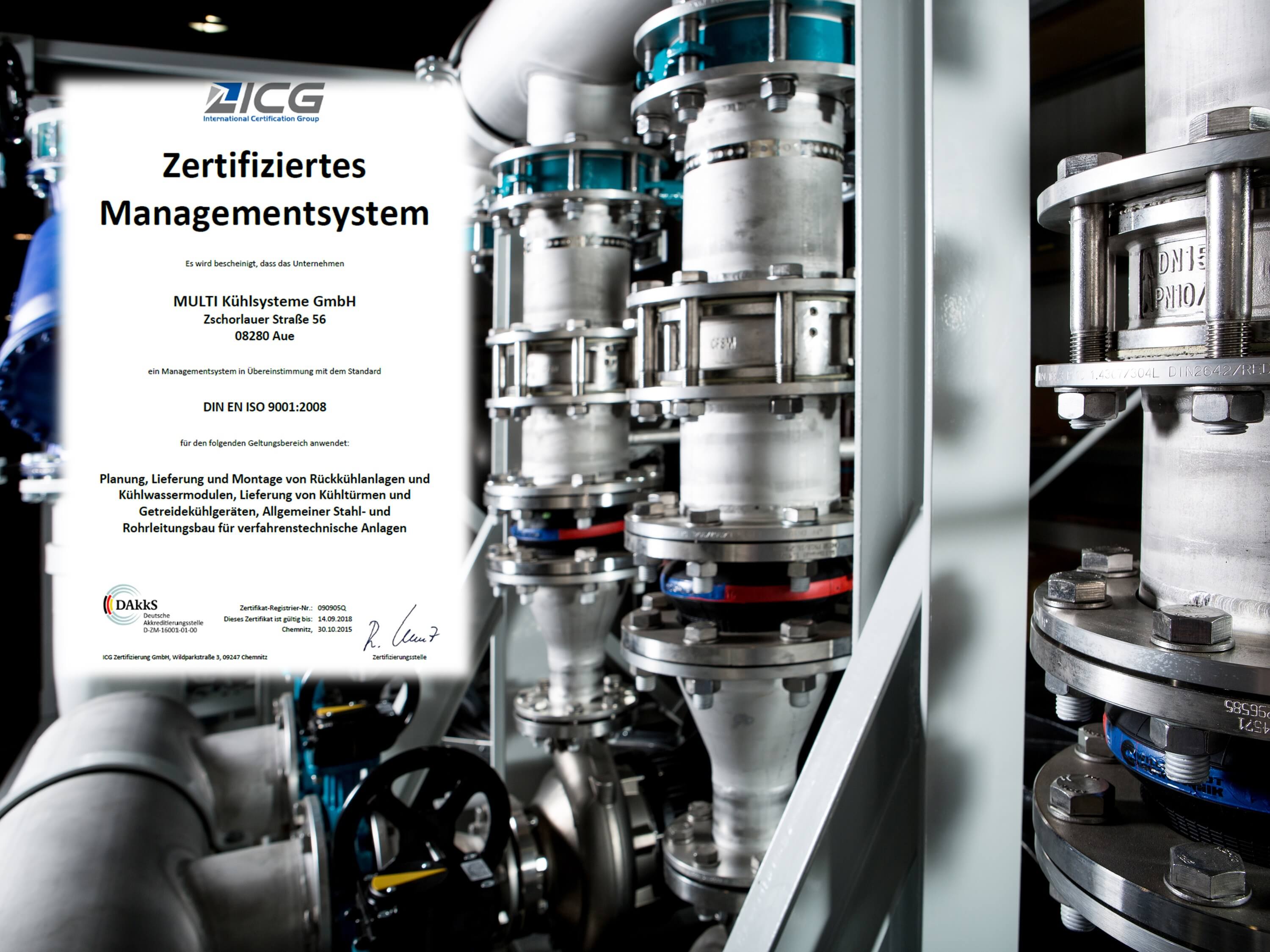
DIN EN ISO 9001:2008 Surveillance Audit Successfully Passed
In December 2016, our scheduled short/surveillance audit in accordance with DIN EN ISO 9001:2008 was successfully conducted. Once again, we were able to demonstrate an effective management system based on ISO 9001 for the areas of planning, delivery, and installation of cooling systems, as well as for cooling towers and the associated general steel and piping construction.
For us as a company, the introduction and ongoing maintenance of a lived quality management system is a strategic decision and a key foundation for sustainable success. In particular, the customer-oriented approach of DIN EN ISO 9001 serves as both a motivation and an obligation to align our processes and procedures with the needs and expectations of our customers, enabling us to respond appropriately and at an early stage to new market developments. The standard also provides the basis for the continuous improvement process of our management system. This ongoing improvement within the framework of ISO 9001 is essential for healthy corporate development and, when applied consistently, enhances our company’s performance potential and secures the organization’s competitive advantage.
Revision to DIN EN ISO 9001:2015
The revised version of ISO 9001:2015 has been published since September 2015. For all companies certified under the previous standard, a three-year transition period applies. MULTI Kühlsysteme GmbH has decided to complete this transition within the required timeframe in 2017.
The new revision is based on a standardized ISO “High Level Structure”, with the aim of harmonizing different management system standards (e.g. ISO 50001 Energy Management) into a uniform structure.
In addition to the process-oriented approach, the revised standard places a stronger emphasis on a risk-based approach. As a result, companies are required to systematically address relevant risks and opportunities and to assess potential risks within their processes. Another new aspect of the 2015 revision concerns requirements for handling “organizational knowledge.” This involves identifying the knowledge necessary within the organization, maintaining and sharing it, and acquiring additional knowledge as required.
For MULTI Kühlsysteme GmbH, the transition to the revised standard—and the opportunities associated with it—represents an important step toward a successful and sustainable future.