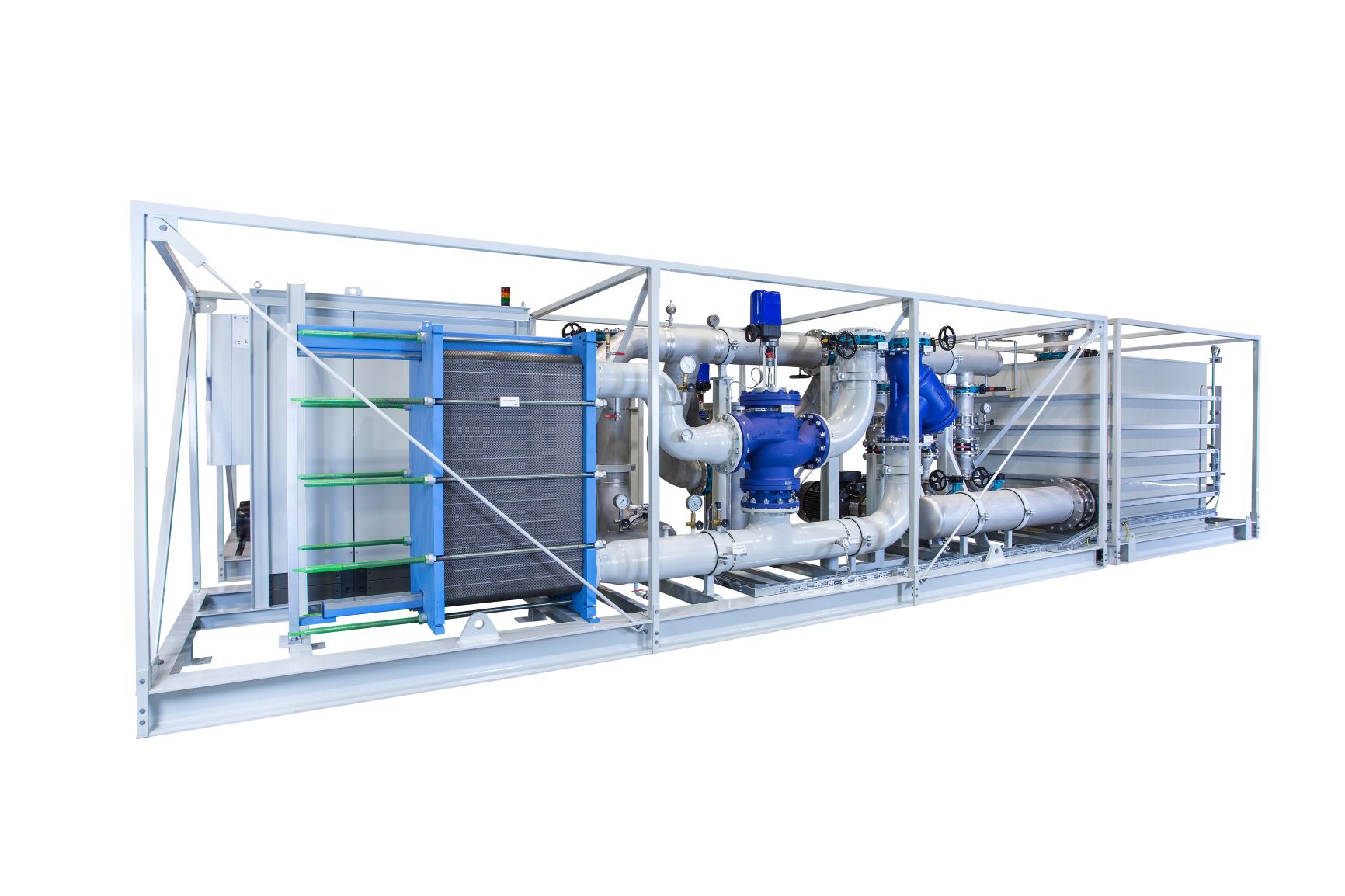
Heat exchanger stations are used in industrial applications to dissipate process heat across a wide range of uses (chemical industry, glass industry, metal processing, and many others). By means of a heat exchanger station, a system separation is achieved between the internal machine or plant cooling circuits and the corresponding external (recooling) circuits. The “process heat” generated during operation is transferred via a heat exchanger to the external cooling medium.
This type of system separation may be required for safety-related reasons or is implemented due to contaminated or special media (such as emulsions, oils, or acids). Multi Kühlsysteme GmbH manufactures heat exchanger stations according to customer specifications in various performance classes.
Also in view of the current legal framework in Germany (42nd BImSchV), a separation between consumers and recoolers (e.g. open evaporative cooling systems) is advisable, as it allows open cooling water systems to be kept relatively small. This reduces potential sources of microbiological contamination. Another advantage is the potential for savings through the reduced use of water treatment chemicals. In closed consumer circuits, significantly lower consumption can generally be expected.
Areas of Application and Features
-
Typically designed in modular construction, with heat exchangers separating “contaminated” and “clean” circuits, meeting the highest requirements for cooling water quality
-
Industrial applications across all common sectors (furnace cooling, electroplating, chemical industry, integration into existing hall cooling networks, etc.)
-
Operation with water (for open systems) or water-glycol mixtures (for closed systems)
-
Usually intended for indoor installation (protection against frost and weather influences); however, outdoor installation in container design is also possible in most cases
Flexible implementation
-
Advantageous concept for export projects: fully assembled, factory-tested heat exchanger stations are delivered to site as ready-to-connect system components; on-site work is limited to installing a relatively small number of connecting pipes and cables
Design and Configuration
-
Base frame with corrosion protection or container solution
-
Heat exchanger designed as a coaxial heat exchanger, plate heat exchanger, or shell-and-tube heat exchanger, depending on the application
-
Optional intermediate vessel or buffer tank
-
Pump system
-
Cooling water filter
-
Water conditioning system
-
Various valves and fittings
-
Internal piping made of plastic materials (PE, PVC), carbon steel, or stainless steel
-
Control cabinet with complete control and regulation system including PLC
-
Internal wiring of all measuring points and consumers
-
Service-friendly design with excellent accessibility
In these systems, the heat exchanger forms the central component. It enables the required system separation between the internal cooling circuit of the industrial application or plant and the external cooling circuit. Heat transfer between the internal and external cooling media takes place via the heat exchanger. The systems are equipped with extensive sensor technology, ensuring fully automatic operation with high availability. Control is managed by a PLC, which is operated via a touch panel featuring a customized, clearly visualized system schematic for maximum user-friendliness.
Should you have any questions or be interested in receiving a quotation, the specialists at Multi Kühlsysteme GmbH are always available to assist you. You are welcome to use our contact form to get in touch.